


Ruling expands possibilities for paraplegics
An elite rock climber left paralysed by a traffic accident has won his High Court claim for a hi-tech exoskeleton to improve his mobility. Boase Cohen & Collins Associate Stephanie Lai and Trainee Mandy Tsang examine the case and its implications.
Hong Kong, 5 May 2020: The High Court recently handed down a judgment which may have ramifications for future paraplegic or substantially disabled plaintiffs. A novel claim was brought by the plaintiff in the case of Lai Chi Wai v Tong Hung Kwok and another [2020] HKCFI 628 for the provision of an exoskeleton – essentially, a mechanised frame which fits closely to the body and assists with movement.
The Claim for Exoskeleton
The Plaintiff, who was a world champion rock climber, was involved in a traffic accident which made him a paraplegic. He made a claim for an exoskeleton to assist his mobility, a claim unprecedented in the common law jurisdiction. The only example of something similar noted by the Court was a UK case where a settlement was reached between the parties which included the provision of an exoskeleton. As a part-time member of staff in a pilot program for testing the use of exoskeletons, the Plaintiff believed such a device would help him in regaining his confidence by allowing him to walk and look at people at eye level as well as generally being more independent.
A single joint expert was engaged to assist the Court with the question of whether the exoskeleton was appropriate for the Plaintiff. The expert defined an exoskeleton as an active mechanical device that is essentially anthropomorphic in nature, worn by an operator and fitting closely to his or her body, and working in concert with the operator’s movements. He concluded the device could have many health benefits to the Plaintiff as well as providing him with an improved sense of well-being. The expert also expressed his opinion that the Plaintiff had shown commitment to using and would likely be a regular user of the exoskeleton.
The Decision
The Court highlighted that the purpose of providing aids and equipment was to place the Plaintiff, as nearly as possible, in the same position he would be if not injured. However, before the Court could make a provision for aids and equipment, it had to determine whether or not they were reasonably necessary for rehabilitation and whether the cost was reasonable having regard to the living standard in Hong Kong.
In making its decision, the Court emphasised that the Plaintiff’s ability to make effective use of the equipment was a critical consideration. While the Court agreed that the costs of an exoskeleton and its replacements were high, they did not fall within the category of an unwarrantable luxury and therefore were not outside the reach of the current standard of living in Hong Kong. In the circumstances, the Court allowed the provision of an exoskeleton as being reasonably necessary to restore a degree of mobility to the Plaintiff.
That said, following a submission by the defendants, the Court agreed to some reduction to the award of PSLA (pain, suffering and loss of amenities) as the exoskeleton would restore the Plaintiff’s mobility to some extent.
Implications
There are some important implications stemming from this decision which may have long lasting consequences. It would appear future paraplegic claimants may claim novel aids and equipment provided that they satisfy the relevant criteria below:
i. reasonably necessary for the purpose of rehabilitation;
ii. the costs of the equipment are reasonable having regard to the living standard in Hong Kong; and
iii. the injured person’s ability to make effective use of the equipment.
This may mean that claimants can access a much wider range of equipment and treatments that may not have been available in the past because they were of a “novel” nature, and the decision would appear to represent an expansion of what aid and equipment may be considered reasonable for a claimant. It remains to be seen whether the courts of Hong Kong will take this further and apply this principle to non-paraplegic claimants requiring or desiring such novel equipment.
If any advice or assistance is needed, please contact our Insurance & Personal Injuries Department:
Telephone: (+852) 3416 1711
Fax: (+852) 2529 5035
Email: teddy@boasecohencollins.com
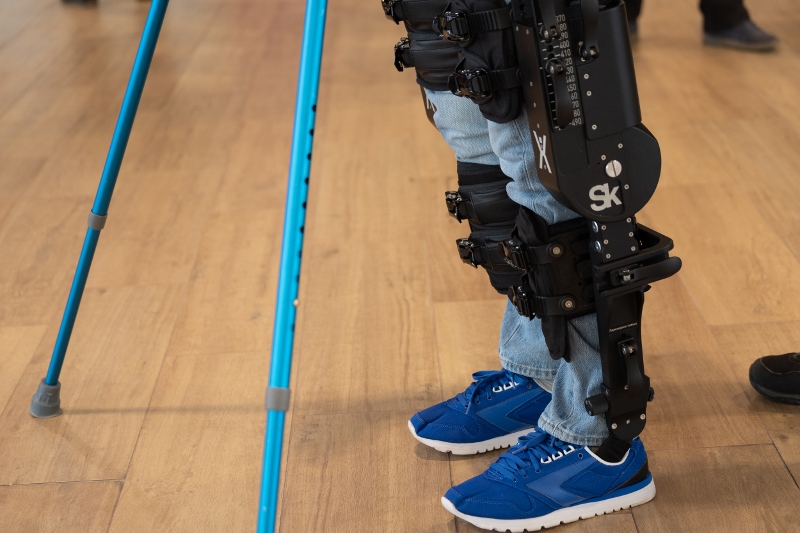
Exoskeletons are becoming increasingly prevalent in aiding human mobility.